

Diamond Capital Management's Market Commentary
October, 2026
Erik Gerlitz
Assistant Vice President and Portfolio Manager
Executive Summary:
- Fed policy remains restrictive: Persistent inflation and resilient growth prompted a 25-basis-point rate increase, with further tightening possible.
- Higher yields are resetting market trade-offs: Rising bond yields are pressuring equity valuations and improving the relative appeal of fixed income.
- Equity leadership is increasingly concentrated: Narrowing market breadth favors diversification, disciplined security selection, and valuation awareness.
The Federal Reserve raised the target range for the federal funds rate by 25 basis points to 3.75%–4.00%, 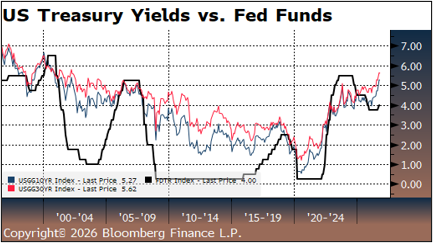 marking its first interest rate increase since 2023. Citing persistent inflation and continued economic resilience, policymakers also indicated that another increase could be appropriate later this year.
The Federal Reserve operates under a dual mandate: price stability and maximum employment. Core personal consumption expenditures (PCE) inflation, which excludes food and energy, rose 3.0% year over year in August, remaining above the Fed’s 2% objective. At the same time, the labor market remained healthy, economic activity continued to expand, and measures of both manufacturing and services activity remained in expansion territory. Together, these conditions supported the Fed’s decision to tighten monetary policy.
Although the Fed directly controls only the federal funds rate, intermediate- and long-term Treasury yields also rose materially. During September, the 10-year U.S. Treasury yield increased 54 basis points, while the 30-year yield rose 39 basis points. Government bond yields in several global markets also moved higher during the month. Rising yields can pressure equity valuations by increasing discount rates and offering investors more attractive alternatives to stocks. Nevertheless, continued earnings growth may help offset some of that pressure, particularly for companies capable of sustaining strong profitability. 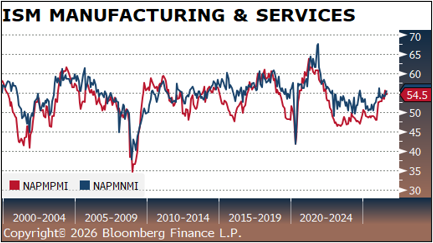
The S&P 500 was approximately flat in September, but the headline result masked considerable weakness beneath the surface. At the beginning of the month, roughly 70% of the index’s constituents traded above their 200-day moving averages; by month-end, that share had fallen closer to 40%. This deterioration in market breadth suggests that performance became increasingly concentrated in a relatively small group of companies. Growth stocks—particularly semiconductor companies—led the market, with S&P 500 growth outperforming value by more than 5 percentage points and semiconductor stocks outperforming value by more than 12.5 percentage points during the month.
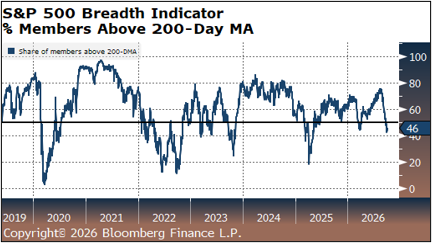
Taken together, rising yields and narrowing market leadership suggest a more challenging environment for equities. Strong corporate fundamentals remain supportive, but elevated valuations and greater performance concentration reinforce the importance of diversification, disciplined security selection, and attention to valuation.